
Student Moves: UCLA, USC, and Off-Campus Housing Logistics
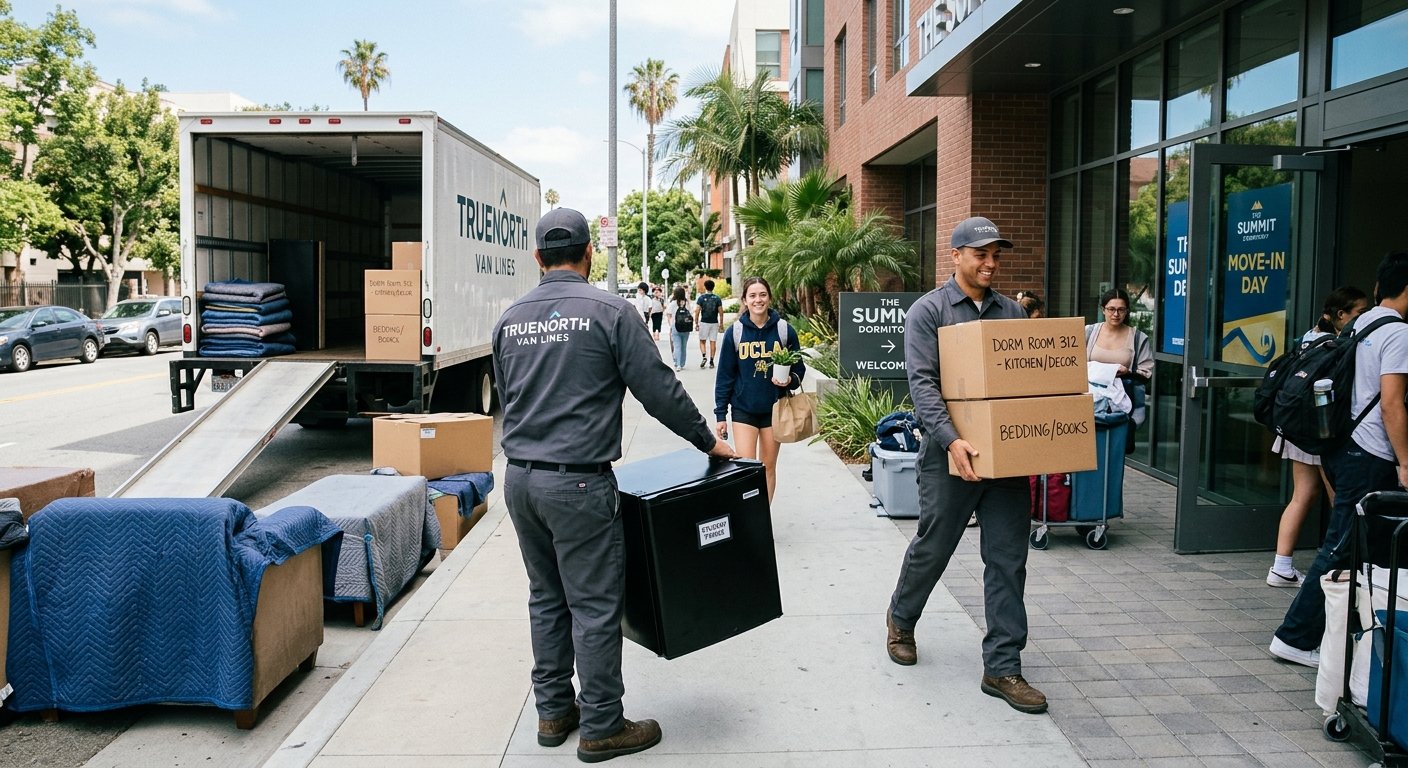
Student moving days in Los Angeles can feel like controlled chaos. You are balancing class registration, housing paperwork, roommates, and figuring out how to get all your stuff from home to campus or a new off-campus apartment, usually on a very specific date and time window. Parking is tight, elevators are crowded, and families are trying to unload as fast as possible.
Whether you are heading into a UCLA dorm, moving into USC housing, or relocating to an off-campus apartment in Westwood, Koreatown, Downtown LA, or beyond, a planned local move makes a huge difference. The right timeline, packing strategy, and moving crew can turn a stressful day into a manageable, even smooth, experience.
This guide from TrueNorth Van Lines walks through a full, practical plan for student moves in Los Angeles. You will learn how to schedule your move around school move-in rules, what to pack (and what not to), how to compare student moving quotes, what affects cost, and how to coordinate with roommates and parents so everyone is on the same page.
Throughout the guide, we will also explain where professional help from a licensed and insured local mover such as TrueNorth Van Lines can simplify the process, without pushing services you do not need. Use this as your game plan for a calmer, better organized move in LA.
Key takeaways
- Student moves in Los Angeles are highly time-sensitive because of school move-in windows, elevator bookings, and street parking limits.
- A clear, planned packing strategy (what goes in boxes vs. bags vs. suitcases) saves time on move-in day and keeps hallways and elevators moving.
- Cost for a local student move typically depends on time, access conditions, elevator distance, stairs, and how prepared everything is when movers arrive.
- Accurate inventories, labels, and notes for fragile and high-value items help movers load and unload more safely and efficiently.
- Students should keep essentials, documents, medications, and first-night items with them rather than on the moving truck.
- Comparing at least two or three written estimates and asking clear questions helps you choose a licensed, insured mover that fits your budget.
- TrueNorth Van Lines offers flexible local moving, packing, and storage options designed to fit different student needs and budgets.
Why LA student moves are different
Los Angeles has its own set of moving challenges, especially around college campuses. Understanding them upfront lets you plan a more efficient move and avoid last-minute issues.
Traffic and timing around campus
Both UCLA and USC sit in busy, high-traffic areas. On official move-in days, nearby streets are often packed with cars, rideshares, and moving trucks. Building staff may provide specific time blocks and routes for unloading.
For example, a UCLA dorm might assign your room a 90-minute unloading window at a specific curb. USC housing could require you to check in at a staging area before you are allowed to drive into the campus housing zone. These details matter when planning when your movers arrive and when your truck can legally park.
Parking, permits, and loading zones
Parking is one of the biggest issues in LA student moving. Some buildings have loading docks or dedicated zones; many do not. In busy neighborhoods, finding a safe, close spot for a moving truck can add time and cost if not planned well.
- Campus dorms typically provide unloading zones but with strict time limits.
- Off-campus apartments may not have any reserved parking; street parking rules will apply.
- Some buildings may require advance notice or permits for larger trucks.
When you speak with a mover, always mention what you know about parking and building rules. The more detail they have, the better they can estimate time and send the right size truck.
Elevators, stairs, and long carries
Dorms and mid-rise apartment buildings usually rely on elevators. On move-in weekend, those elevators are under heavy demand. Some buildings will schedule elevator slots for move-ins; others are a first-come, first-served situation.
Stairs and long carries (long distances from truck to unit) also affect your schedule. If movers have to walk around the building, through a courtyard, or up several flights, the move will take longer than an easy ground-floor access.
Parents, roommates, and coordination
Student moves are often group projects. Parents may drive in from out of town. Roommates and their families are arriving around the same time. This can quickly crowd a small dorm room or apartment.
Planning ahead about who brings what (for example, one person brings the TV and stand, another brings the microwave and dishes) avoids duplicates and wasted effort. It also helps you decide how much actually needs to go on the moving truck.
Choosing local moving, long-distance, packing, or storage
Even though this guide focuses on local moves in Los Angeles, many students are also coming from out of state or other parts of California. It helps to understand how different services from TrueNorth Van Lines can fit your situation.
Local moving for LA-area students
If you are moving within the greater Los Angeles area, you are likely looking for local moving services. This might include:
- Moving from home in LA County into a UCLA or USC dorm.
- Moving between apartments in the same neighborhood (for example, from one Westwood apartment to another).
- Moving from on-campus housing to off-campus housing nearby.
Local moving is usually charged based on time, number of movers, and equipment needed. A well-planned, compact student move can often be completed in a few hours if everything is packed and ready.
To see how local moving might fit your situation, you can review the local moving services TrueNorth Van Lines provides and consider which level of help you want with loading and unloading.
When long-distance moving services make sense
If you are coming to LA from another city or state, your move may be considered long-distance. In that case, you might use a combination of:
- Long-distance moving services for your main belongings.
- Lighter luggage and personal items traveling with you by car or plane.
In long-distance scenarios, timing between when your items are picked up and when your move-in window opens becomes critical. Work closely with your mover on delivery windows and backup plans, especially if your building only allows moves on certain days.
Adding professional packing help
Student moves are often packed at the last second, between finals, summer work, and goodbyes. That is how items get lost or damaged. One way to stay on track is by using professional packing services for part or all of your belongings.
Options can include:
- Full packing: The crew packs your entire room or apartment.
- Partial packing: The crew packs only fragile or hard-to-pack items, such as kitchenware, decor, or electronics.
- Supplies-only: You pack yourself, but purchase materials and get guidance from your mover.
Professional packing is especially useful if you have a tight timeline or are balancing work and travel around your move.
Short-term and long-term storage
There are times when your lease end date and new housing start date do not line up, or you are going home for summer but want to keep your LA items near campus. In those cases, secure storage services can be a smart option.
Scenarios where storage can help include:
- Summer storage between spring move-out and fall move-in.
- Gap storage when your old lease ends before your new lease begins.
- Studying abroad but planning to return to LA afterward.
Movers can pick up, store, and then redeliver your belongings to your new dorm or apartment when you are ready.
Student moving timeline for UCLA, USC, and off-campus
A planned timeline is the backbone of a smooth student move. While exact dates will depend on your school and housing, the structure below gives a clear model you can follow and adjust.
| Timeframe | Key tasks | Notes |
|---|---|---|
| 4–6 weeks before move | Confirm housing, collect move-in rules, request quotes | Ask about elevator and parking procedures |
| 3–4 weeks before move | Book your movers, order packing supplies, plan with roommates | Choose move date and time window. |
| 2 weeks before move | Start packing rarely used items and seasonal clothes | Label by room and category. |
| 1 week before move | Finish most packing, set aside essentials kit, confirm details with movers | Send building rules and parking info to movers. |
| 1–2 days before move | Disassemble furniture, defrost fridge (if needed), clear pathways | Confirm elevator time if required. |
| Move day | Be ready before crew arrives, manage check-in, direct items to correct room | Keep documents, keys, and valuables with you. |
Coordinating with UCLA, USC, and building rules
Each campus and building has its own specific rules. Typical requirements you may encounter include:
- Pre-assigned move-in time slots.
- Required check-in at a central location before driving to your building.
- Badges or wristbands to access campus roads during move-in.
- Restrictions on truck sizes or where trucks can wait.
As soon as you receive these details, forward them to your mover. This allows the dispatcher to select appropriate truck sizes and build accurate travel time into your schedule.
Sample wording to send your mover:
«Our dorm at UCLA gave us an unloading window from 9:00–10:30 a.m. on September 22, and they said trucks must enter campus from the north gate and cannot stay parked longer than 30 minutes. We are on the 6th floor with an elevator. Can we schedule the crew to arrive a little before 9 so we can unload during our window?»
What affects the cost of a student move
Student moving budgets are often tight. Understanding what drives cost gives you more control and helps you use professional movers where they matter most.
Key cost factors for local student moves
| Cost factor | How it affects price | How you can manage it |
|---|---|---|
| Move size and weight | More items usually require more time, a larger truck, or additional movers. | Declutter, donate, or sell items you will not use at school. |
| Distance and travel time | Longer drives or heavy traffic can add to overall time on the job. | Choose move times that avoid peak traffic where possible. |
| Access conditions | Stairs, long carries, and waiting for elevators add time to loading and unloading. | Reserve elevators if allowed and share accurate access details with your mover. |
| Packing readiness | If items are not boxed or disassembled when movers arrive, they will need more time. | Be fully packed and organized before your scheduled start time. |
| Special handling items | Large TVs, fragile decor, or heavy furniture may require extra care or equipment. | List these items in advance so movers can plan for them. |
For a rough planning tool, students can also use a moving cost calculator as a starting point, then request a detailed quote based on their specific inventory and building rules.
How being planned reduces cost
Being well planned helps your move go faster and more smoothly, which can lower overall cost. For example:
- Packed and labeled boxes can be stacked quickly on dollies.
- Reserved elevators reduce waiting time.
- A clear floor plan in your new space keeps movers from moving items multiple times.
It is worth spending a few hours on careful planning to save both time and stress on move day.
Packing strategies for dorms and shared apartments
Good packing is one of the biggest differences between a chaotic move-in and one where you can actually find your bedding and laptop charger that night. Here is how to approach packing specifically for student life in Los Angeles.
What to bring and what to leave
Dorms and shared apartments have limited space, and many items can be purchased locally once you arrive. Focus on:
- Clothing appropriate for LA’s climate (layers for cooler evenings, comfortable everyday wear).
- Study essentials: laptop, chargers, notebooks, desk lamp, storage bin for school supplies.
- Daily living basics: bedding, towels, minimal kitchen gear if you have access to a shared kitchen.
- Sentimental items in small quantities to make your space feel like home.
Consider leaving behind or delaying:
- Large collections of books you will not use for class.
- Bulky furniture not allowed in dorms or that duplicates what your roommates are bringing.
- High-value collectibles or items with irreplaceable sentimental value that might be better kept at home.
Smart box categories for student moves
Organize boxes by how you will use items during the semester, not just where they came from at home. Here is a useful structure:
| Box type | What to include | Notes for movers |
|---|---|---|
| Bedding & comfort | Sheets, comforter, pillows, mattress pad | Mark as «Open first» and «Dorm room». |
| Study setup | Laptop stand, monitor, cables, notebooks, desk supplies | Label «Desk/Study» and «Fragile» if needed. |
| Bath & cleaning | Towels, toiletries, shower caddy, cleaning wipes | Indicate «Bathroom» and which roommate it belongs to. |
| Kitchen starter | Mugs, basic dishes, one pan, utensils, reusable containers | Mark «Kitchen» and «Fragile» for glass items. |
Using categories like these helps movers place boxes in the right part of your dorm or apartment and helps you unpack in a logical order.
Using suitcases, bins, and bags wisely
- Suitcases are great for clothing and heavier items because they have wheels.
- Clear plastic bins help you quickly see contents and are useful for under-bed or closet storage once you arrive.
- Heavy-duty bags can work for soft items like bedding or clothing, but avoid putting fragile items in them.
Stick to containers that close securely. Avoid open-topped laundry baskets full of small items; they are harder to stack and more likely to spill in transit.
Labeling best practices
- Put your name, destination room (for example, «UCLA Hedrick 6A»), and box category on two sides and the top.
- Use simple color coding: one color for bedroom items, another for bathroom, another for shared living areas.
- Add handling instructions: «Fragile,» «This side up,» or «Heavy» when appropriate.
Sample label text:
«USC – Cardinal Gardens, Apt 312 – Bedroom B – Bedding & Towels – Open First»
Inventory and labeling: thinking like a moving crew
An accurate inventory is not only useful for you; it is also critical for getting accurate quotes and helping movers plan the right truck and crew size.
Creating a simple student move inventory
You do not need a complex system. A simple list divided into categories works well. Here is an example layout:
| Category | Example items | Quantity |
|---|---|---|
| Furniture | Desk chair, small dresser, bedside table, bookshelf | 4 pieces |
| Electronics | Monitor, TV, gaming console, speakers | 4 items |
| Boxes & bins | Standard moving boxes, plastic bins, small book boxes | 10–15 total |
| Miscellaneous | Mini fridge, floor lamp, rug, bicycle | 4 items |
Share this list with your mover when requesting a quote and again a few days before moving so it reflects any changes.
Flagging fragile and high-value items
Clearly mark boxes that contain fragile or high-value items. When in doubt, communicate more, not less. For example:
- Label a box «Fragile – Monitor» rather than just «Desk.»
- Tell the crew leader which items should not be stacked.
- Keep extremely sensitive items such as certain electronics, personal documents, or jewelry with you rather than on the truck.
How to prepare before the movers arrive
The more prepared you are before your movers arrive, the smoother and faster the move will go. Here is a practical checklist tailored to LA student moves.
One week before move day
- Confirm your move date, time, and building access rules with your moving company.
- Share any updated parking or elevator instructions you receive from UCLA, USC, or your landlord.
- Finalize your inventory and send any changes to the mover.
- Coordinate with roommates so you are not all moving oversized items at the same time.
Two days before move day
- Finish packing the majority of your items, leaving out only essentials for the final day or two.
- Disassemble furniture that movers are not scheduled to disassemble.
- Empty and defrost your mini fridge if it is going on the truck.
- Take photos of fragile items and electronics for your own records.
Morning of move day
- Clear hallways and entryways so movers have easy access.
- Set aside your «do not load» items in a separate space.
- Keep your phone fully charged.
- Have payment method and identification ready.
Sample reminder to send a roommate:
«Movers arrive at 8:00 a.m. on Saturday. Can you please have your boxes labeled and stacked by the door, and make sure the hallway is clear so they can get through quickly?»
How to compare student moving estimates
Not all moving estimates are structured the same way. Comparing them carefully helps you understand what you are paying for and avoid surprises on move day.
What to look for in each estimate
| Estimate element | Why it matters | Questions to ask |
|---|---|---|
| Hourly rate or flat cost | Determines the base price of your move. | Is this hourly or flat? What is included in that rate? |
| Number of movers and truck size | Affects how quickly your move can be completed. | How many movers are included? What size truck will you bring? |
| Travel or minimum charges | Some companies have a minimum number of hours or travel time. | Is there a minimum charge or travel time added? |
| Packing and materials | Clarifies whether packing help and supplies are included. | Does this include packing? Are there extra charges for boxes or tape? |
Questions to ask before booking
- Are you licensed and insured for local moves in Los Angeles?
- What happens if my building changes our move-in time or elevator access?
- How do you handle narrow hallways or tight stairwells?
- What is your process if something is accidentally damaged?
- Do you offer any student-friendly scheduling options or smaller crews for compact moves?
If you are comparing several options, it can help to talk through your situation with one of the TrueNorth Van Lines coordinators and review the moving services that best fit your needs.
Moving day checklist and what to keep with you
When move day arrives, you will have a lot happening at once: coordinating with family, meeting roommates, checking in with building staff, and directing movers. A short checklist keeps you on track.
Moving day checklist
- Confirm arrival time with movers and share your cell number with the crew leader.
- Pack a small backpack with documents, wallet, keys, and chargers.
- Have your school or building move-in details ready to show at check-in.
- Walk movers through your space and explain any special items or instructions.
- At destination, direct boxes to the right areas immediately: bedroom, bathroom, shared areas.
- Before the movers leave, walk through to confirm everything is off the truck and in the right place.
What to keep with you, not on the truck
Some items should stay with you at all times rather than being loaded on the moving truck.
- Wallet, ID, student ID, and payment methods.
- Medications and any medical devices or supplies.
- Important documents: housing paperwork, class schedule, financial aid notes.
- Laptop, phone, and primary chargers.
- One or two changes of clothes and basic toiletries.
- Keys and access cards to your building or apartment.
Think of this as your «first 24 hours» kit. Even if the truck is delayed or you cannot fully unpack right away, you will have what you need to function.
Common LA student moving mistakes and how to avoid them
Student moves come with patterns of repeat mistakes. Knowing them in advance helps you avoid unnecessary stress. The table below outlines several common problems and simple countermeasures.
| Common mistake | What happens | How to prevent it |
|---|---|---|
| Ignoring move-in time windows | Truck arrives when you cannot unload, causing delays or rescheduling. | Schedule movers only after you receive official move-in rules. |
| Underestimating traffic and parking | Crew spends extra time finding parking or stuck in traffic. | Share exact addresses, parking notes, and best routes with your mover. |
| Packing at the last minute | Boxes are poorly labeled, items get lost, move takes longer. | Start packing at least 1–2 weeks ahead and use a clear labeling system. |
| Bringing too much furniture | Rooms feel crowded, some items may not fit or be allowed in dorms. | Check floor plans and talk to roommates before deciding what to bring. |
Staying aware of these issues and building them into your planning makes your move more predictable and less stressful.
Helpful TrueNorth Van Lines services
How TrueNorth Van Lines supports student moves
TrueNorth Van Lines provides local and long-distance moving support for students, families, and faculty relocating within or to the Los Angeles area. The goal is to make a complex day more manageable by handling the heavy lifting and logistics so you can focus on check-in, orientation, and settling in.
Service approach for student moves
- Licensed and insured crews who understand dorm and apartment access challenges.
- Careful handling and padding for furniture, electronics, and dorm essentials.
- Flexible service levels from basic loading and unloading to full packing and storage.
- Clear communication about arrival windows, timelines, and what to expect on move day.
If you are planning a student move and want structured help, you can request a free moving quote based on your inventory, building rules, and preferred move date. Students coming from outside LA can also explore service areas and how long-distance and local services can work together.
Frequently asked questions
How far in advance should I book movers for a UCLA or USC move-in?
For peak move-in periods, aim to book 4–6 weeks in advance once you receive your official move-in date and time window. Earlier booking gives you more options for preferred days and times.
Can movers handle both my dorm items and my off-campus storage at the same time?
Often, yes. Movers can pick up from multiple locations or deliver some items to storage and others to your dorm or apartment, as long as this is planned into the estimate and schedule ahead of time.
What is the best way to save money on a student move in Los Angeles?
The biggest savings usually come from reducing volume, packing efficiently, being ready when the crew arrives, and choosing a realistic move window that avoids unnecessary delays with traffic and elevator access.
Do I need to be present when the movers load and unload?
It is strongly recommended that either you or a trusted adult be on-site during both loading and unloading to answer questions, direct boxes, and review paperwork or final walk-throughs.
Can movers assemble my bed, desk, or other furniture in my dorm or apartment?
Many moving crews can handle basic disassembly and reassembly of common furniture. Confirm what is included in your estimate and let the mover know ahead of time what furniture you need help with.
What if my building only allows moves during specific hours?
Provide those rules when you request your quote so dispatch can schedule your move inside the allowed window. Good planning between you, the mover, and building management helps avoid conflicts.
Are tips for student movers expected, and how much is typical?
Tipping is not mandatory, but many customers choose to tip based on service quality. A common range is a set amount per mover or a small percentage of the total cost, adjusted for the complexity of the move.
How do I estimate how many boxes I will need for my student move?
Count major categories: clothing, bedding, books, decor, and kitchen items if applicable. A typical student move might use 8–15 boxes plus a few bins, but the exact number depends on how much you bring.
Sources referenced in this guide
Guidance in this student moving guide is based on practical field experience from professional moving crews and coordinators, as well as common recommendations found in:
- Federal Motor Carrier Safety Administration consumer guidance on choosing movers and understanding estimates.
- U.S. Department of Transportation moving guidance regarding carrier responsibilities and consumer rights.
- State transportation and consumer protection agency materials on local moving regulations.
- Building management move-in and move-out requirements for dorms and multifamily properties.
- Written moving estimates, bills of lading, and carrier service agreements that outline pricing, services, and valuation options.
Students are encouraged to review their own housing agreements and school-specific move-in details in addition to this general planning guide.
This guide is general moving information, not legal, insurance, or regulatory advice. Moving requirements, pricing, access rules, and coverage options may vary by location, move type, building rules, and service agreement.
For additional planning ideas and moving checklists, you can browse the TrueNorth Van Lines blog for more resources tailored to local and long-distance moves.