
Moving Insurance Explained: Released Value vs. Full Value
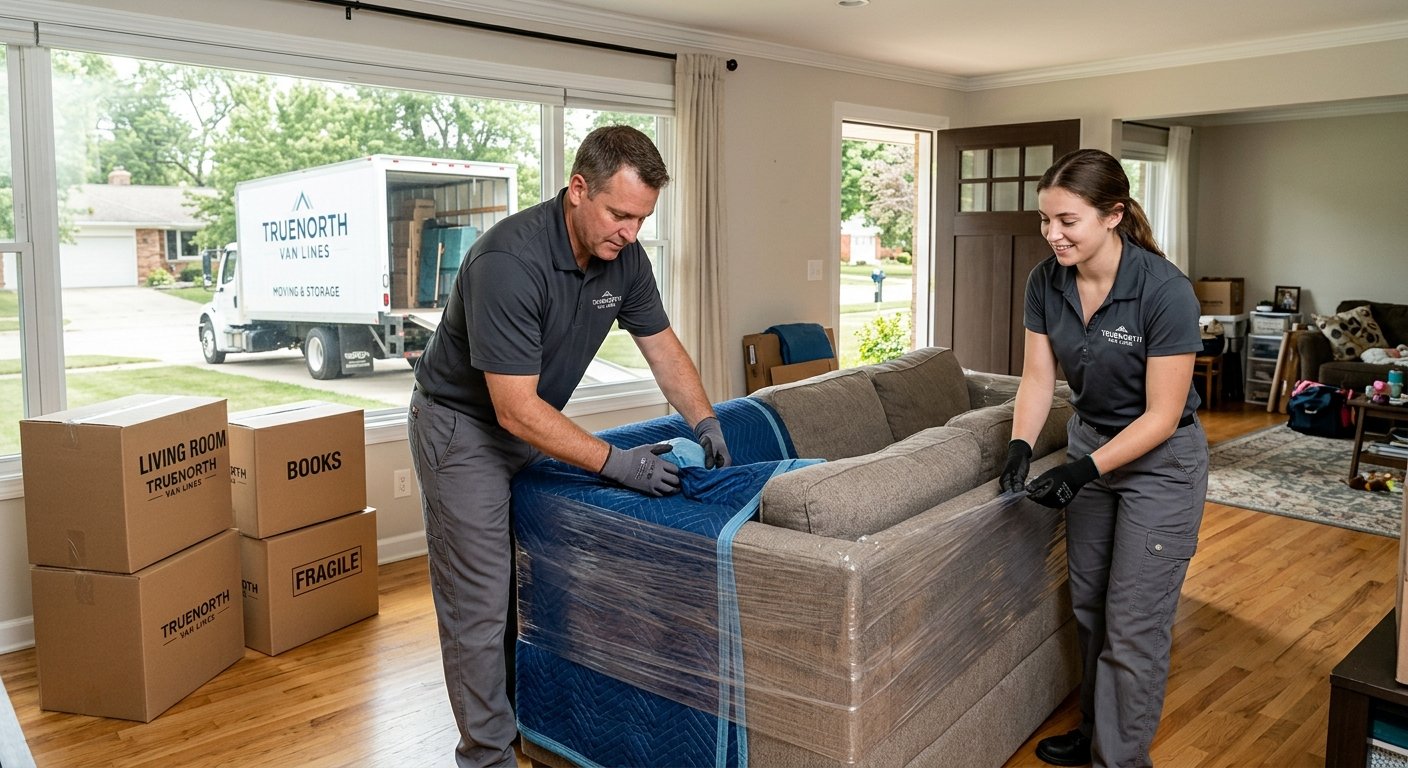
When you book a professional moving company, you are trusting a crew with nearly everything you own. Furniture, electronics, family photos, important files — it all goes on the truck. Even with careful movers and good planning, there is always some risk in moving. That is why understanding how moving insurance and movers liability coverage work is just as important as choosing the right move date or packing supplies.
Many customers are surprised to learn that the basic protection included with their move is very limited, and that they need to make an active choice if they want stronger coverage. The two most common options are released value protection (the basic level required on interstate moves) and full value protection (a higher level of coverage that comes with an additional cost). Knowing the difference between these options before moving day helps you make an informed decision that matches your budget, your belongings, and your risk comfort level.
This guide from TrueNorth Van Lines explains moving insurance and liability coverage in plain language. We will walk through what released value and full value protection mean, how claims work, what movers are actually responsible for, and how to choose the right level of protection for your local or long-distance move. You will also find checklists, comparison tables, and questions to ask your mover before you sign your paperwork.
Our goal is simple: give you practical, reliable information so you can plan a safer move, understand your options, and feel more confident when you book long-distance moving services or local moving services with TrueNorth Van Lines or any professional mover.
Key takeaways
- Moving companies are required to provide at least a basic level of protection, but that basic “released value” option is very limited.
- Full value protection typically offers much stronger coverage, but it comes with an additional cost based on the value of your shipment.
- Coverage choices, inventory quality, and how you pack high-value items can all affect what is covered and how claims are handled.
- Written estimates, bills of lading, and valuation forms control what protection you actually have on moving day.
- Planning your coverage early and asking clear questions helps you align cost, risk, and peace of mind for your move.
- Certain items and situations are commonly excluded from coverage, so you may want separate insurance for special or high-value belongings.
- TrueNorth Van Lines provides clear explanations and documentation so customers can select the coverage option that fits their needs.
Why moving coverage matters
Even the most carefully planned and well-executed move involves a lot of steps: packing, loading, driving, unloading, and navigating elevators, stairs, and narrow hallways. Professional movers use pads, straps, dollies, and loading techniques to reduce risk, but movement and handling always carry some possibility of damage or loss.
That is where moving insurance explained in terms of valuation and movers liability coverage becomes important. The coverage you choose determines what happens if something goes wrong, how much the mover is responsible for, and how any compensation is calculated.
Realistic risks on a normal move
Examples of things that can happen during a local or long-distance move include:
- A TV tips slightly in transit and arrives with a cracked screen.
- A dresser gets a deep scratch going up a tight staircase.
- A box of dishes experiences more vibration than expected and a few plates crack.
- A piece of furniture is misplaced or mixed in with another shipment during a complex long-distance move.
None of these are common when a move is properly planned and professionally handled, but they are possible. Moving coverage is about planning for the “what if” scenarios so you are not forced to absorb the full cost of replacement or repair on your own.
Coverage is not automatic — you must choose it
For interstate moves, federal regulations require movers to offer at least two levels of liability coverage: released value protection and full value protection. Local and intrastate moves may be governed by state rules, but the same basic idea applies: the mover offers coverage options, and you select one in writing before the move.
Many customers assume that “the mover’s insurance” automatically covers the full value of their belongings. In reality, the basic level of protection is typically set at a small amount per pound per item, which is often far below replacement cost. Upgrading to stronger coverage is a decision you need to make in advance.
How movers liability coverage works
It is helpful to understand the difference between three related concepts:
- Movers liability coverage — The responsibility your moving company accepts for the items they transport, defined in your contract, tariff, and valuation or coverage election.
- Released value protection — A basic level of liability coverage that values your belongings at a low dollar amount per pound.
- Full value protection — A higher level of liability coverage where the mover is responsible for repair, replacement, or a cash settlement for covered items, up to the declared value of your shipment.
In everyday language, this is often called “moving insurance explained,” but technically movers provide valuation and liability coverage rather than traditional insurance policies. Some customers choose to supplement the mover’s liability with a third-party insurance policy, especially for very high-value items.
Key documents that control your coverage
On a professional move, your coverage is defined in writing, usually in these documents:
- Written estimate — Shows what coverage options you discussed and the cost of any optional protection.
- Valuation or coverage election form — States which level of coverage (released value or full value) you chose and any declared value for the shipment.
- Bill of lading — The official contract of carriage that outlines the terms and conditions of your move, including liability limits.
Sample wording when confirming coverage with a mover:
“Can you show me on my estimate and bill of lading where it states whether I have released value or full value protection, and what the declared value of my shipment is?”
What movers are typically responsible for
While specific terms depend on your agreement and applicable regulations, movers are generally responsible for loss or damage that occurs while your belongings are in their care, custody, and control, subject to the level of coverage you selected and any exclusions or limitations spelled out in the contract.
If damage or loss occurs, the mover usually has the option to repair the item, replace it with a similar item, or offer a cash settlement, depending on your coverage. With released value protection, that settlement can be very small because of the low per-pound limit. With full value protection, the settlement is typically closer to the item’s actual value, up to the overall declared value of the shipment.
What is released value protection?
Released value protection is the basic level of liability coverage that movers are required to offer on interstate moves. It is included in the moving rate at no additional charge, but the protection it provides is very limited.
How released value is usually calculated
Under a typical released value option, your belongings are valued at a set amount per pound per article. A common figure for interstate moves is 60 cents per pound per item. Exact figures can vary by mover and jurisdiction, so always check your documentation.
Here is how that might look in practice:
- A 10-pound lamp damaged beyond repair might be valued at 10 pounds x $0.60 = $6.00.
- A 50-pound flat-screen TV might be valued at 50 pounds x $0.60 = $30.00.
- A 100-pound dresser might be valued at 100 pounds x $0.60 = $60.00.
As you can see, released value does not come close to the actual replacement cost for many household items. That is why it is often best for customers with higher-value belongings to consider full value protection.
Pros and cons of released value protection
| Aspect | Pros | Cons |
|---|---|---|
| Cost | Included at no additional monetary charge with most interstate moves | Provides very limited compensation for damage or loss |
| Valuation method | Simple per-pound formula that is easy to understand | Does not reflect replacement value of many items, especially electronics and furniture |
| Best for | Customers with low-value shipments or very tight budgets | Not ideal for customers with high-value or sentimental items |
If you choose released value protection, it is critical to understand what you are accepting. You are essentially agreeing that, in exchange for no additional coverage cost, the mover’s liability for your belongings will be limited to a small amount per pound per item.
What is full value protection?
Full value protection is a higher level of coverage where the mover’s liability is based on the actual value of your shipment, not just weight. When you select full value protection, you declare a total value for the belongings being moved, and the mover’s liability is generally tied to that amount, subject to the terms of the agreement.
How full value protection works in practice
When you choose full value protection, the mover typically agrees that, if an item is lost, destroyed, or damaged while in their care (and the claim is covered), they will do one of the following:
- Repair the item to the extent reasonably possible.
- Replace the item with a similar item of like kind and quality.
- Offer a cash settlement for the cost of repair or replacement, up to the declared value.
This coverage usually comes with a deductible option and a minimum declared value for the entire shipment, such as a certain dollar amount per pound of the total shipment weight. Exact rules vary by mover and governing regulations.
Pros and cons of full value protection
| Aspect | Benefits | Considerations |
|---|---|---|
| Coverage level | Much closer to the actual value of your belongings; can provide repair, replacement, or cash settlement | More expensive than released value protection |
| Peace of mind | Better suited to customers with higher-value items or longer-distance moves | Requires you to honestly estimate and declare shipment value |
| Deductibles | Choosing a higher deductible may lower the cost of coverage | You will pay the deductible amount out of pocket if you file a claim |
Full value protection is often the better fit for customers moving furnished homes, valuable electronics, or heirlooms — especially on interstate or long-distance moves where travel distance and handling steps increase risk.
Released value vs. full value: side-by-side comparison
To put moving insurance explained in a practical format, here is a high-level comparison of released value vs. full value protection for a typical interstate move. Actual terms are controlled by your written documents, but this gives you a sense of how the options differ.
| Feature | Released value protection | Full value protection |
|---|---|---|
| How liability is calculated | Per-pound value per item (for example, $0.60/lb) | Based on declared total shipment value and coverage terms |
| Included in base move price? | Yes, for many interstate moves | No, additional cost based on declared value and deductible |
| Typical compensation for a 50-lb TV | 50 x $0.60 = $30.00 (example figure) | Repair, replacement, or settlement closer to actual value, minus any deductible |
| Best fit for | Budget-conscious moves with lower-value items | Customers who want stronger protection for household goods |
| Key trade-off | No coverage fee, but very limited payout if something happens | Higher upfront cost for significantly more coverage |
When comparing released value vs. full value protection, think about three things: what you own, what you can afford to replace out of pocket, and how much risk feels acceptable for you.
What affects the cost of moving coverage?
When customers ask why full value protection costs what it does, the answer is that the price reflects the potential liability the mover is accepting. Several factors influence that calculation.
Key cost factors
| Cost factor | How it affects coverage pricing | Planning considerations |
|---|---|---|
| Declared shipment value | Higher declared value usually means higher coverage cost | Make a realistic, honest estimate of what your household goods are worth |
| Move size and weight | Larger shipments often have higher overall values and therefore higher potential liability | Decluttering before your move can lower both moving and coverage costs |
| Deductible choice (if applicable) | Higher deductibles can reduce the cost of full value protection | Balance your willingness to pay out-of-pocket against your desire for lower premiums |
| Move distance and complexity | Long-distance and multi-day moves may involve more handling and transit steps | Many customers choose stronger coverage for long-distance than local moves |
To see how coverage choices affect your overall moving budget, you can use the TrueNorth Van Lines moving cost calculator as a planning tool and then speak with a move coordinator about the cost of different coverage levels.
Timeline to choose your coverage
Coverage decisions should be part of your overall move planning, not a last-minute choice on moving day. Here is a general planning timeline you can adapt for local or long-distance moves.
| Time before move | Coverage planning tasks | Tips |
|---|---|---|
| 4–6 weeks | Request moving estimates and ask each mover to explain released value vs. full value protection | Start a simple home inventory so you can estimate the total value of your belongings |
| 3–4 weeks | Decide which coverage level you think best matches your budget and risk tolerance | Ask for written documentation of how each coverage option is priced |
| 2–3 weeks | Confirm your chosen coverage with your mover and sign the valuation or election form | Review your declaration of value and deductible carefully before signing |
| 1 week | Finalize your inventory, especially for high-value items | Take photos and gather receipts or appraisals for valuables if available |
Do not wait until the crew is standing at your door to think about coverage. Making these decisions early gives you time to compare options and ask for explanations in writing.
Preparing an inventory to support your coverage
Whether you choose released value or full value protection, a clear inventory makes it easier to plan your coverage, verify what was moved, and support any claim if something is lost or damaged.
Simple inventory approach for most households
You do not need a complicated software system to inventory your home. A simple spreadsheet or notebook can work well. Focus on larger and higher-value items first, then group smaller items into box categories.
Here is an example of how you might structure a basic inventory for moving coverage planning:
| Room | Item or box description | Approximate value |
|---|---|---|
| Living room | Sofa, 3-seat, fabric, good condition | $900 |
| Living room | 55″ TV, purchased 2022 | $500 |
| Bedroom | Queen bed frame and mattress | $1,200 |
| Kitchen | 3 medium boxes dishes/glassware | $400 total |
Once you have a rough total for your entire home, you can compare it to any minimum value requirement for full value protection and decide whether to adjust your declared value.
Checklist: Inventory steps before your move
- Walk each room and list large furniture, electronics, and obvious high-value items.
- Group smaller items into categories (for example, “3 boxes of kitchen dishes”).
- Estimate reasonable replacement values for each item or group.
- Add the values to get an approximate total for your shipment.
- Note especially high-value items and keep purchase records or appraisals if available.
- Share questions about any special items with your move coordinator before move day.
Common moving insurance mistakes to avoid
Moving insurance explained properly can help you avoid unpleasant surprises. These are some of the most common issues customers run into when they do not plan coverage in advance.
Typical mistakes and how to avoid them
| Common mistake | Why it is a problem | Better approach |
|---|---|---|
| Assuming basic coverage equals full replacement | Released value protection often pays far less than replacement cost | Ask for moving insurance explained in writing and compare options before choosing |
| Not reading the valuation or coverage election form | You may sign for a coverage level you did not intend to select | Review all coverage documents carefully before signing anything |
| Underestimating shipment value | Declaring too low of a value can limit what you can recover under full value protection | Create a reasonable inventory and discuss questions with your mover |
| Packing fragile items poorly | Improper packing can lead to damage that may not be fully covered | Use quality materials or hire professional packing services |
Sample wording to clarify coverage limits with a mover:
“Can you walk me through scenarios where an item might not be covered or where coverage would be reduced, so I understand the limitations before I decide?”
Questions to ask your mover about coverage
Before you sign a moving contract, it is smart to have a short list of coverage questions planned. Clear answers help you choose between released value and full value protection and confirm that your expectations match your documents.
Checklist: Coverage questions for your mover
- What coverage options do you offer for my move, and how do they differ?
- What is the per-pound amount under your released value protection?
- How is full value protection priced, and what declared value do you recommend for my shipment?
- What deductible options are available, if any, and how do they affect the price?
- Are there any items that are excluded or limited under each coverage option?
- How do you handle high-value items, and do they need to be listed separately?
- If something is damaged, how does the claims process work and what documentation do you require?
- Can you show me exactly where my coverage choice appears on my estimate and bill of lading?
Bringing these questions to your estimate appointment or call makes the conversation efficient and ensures that the mover explains moving insurance in a way you can compare to other estimates.
What to keep with you on moving day
Even with full value protection and careful movers, there are some items you should keep with you rather than loading them on the truck. This protects you and can also make coverage questions simpler if there is ever an issue.
Items to keep under your personal control
- Legal documents, passports, and ID cards
- Financial records, checkbooks, and credit cards
- Medications and medical devices you need access to
- Small electronics that you cannot easily replace (for example, work laptop, external drives)
- Jewelry, coin collections, or small heirlooms
- Keys, garage door openers, and access cards
- Essential moving-day supplies (snacks, drinks, phone chargers)
For high-value items you do send on the truck, consider taking photos and discussing them with your move coordinator. Ask whether they should be listed as high-value on your inventory, especially when using full value protection.
How TrueNorth Van Lines helps with coverage decisions
At TrueNorth Van Lines, we aim to keep moving insurance explained clearly and simply so customers can make informed decisions. We recognize that choosing between released value and full value protection can feel technical, especially when you are also deciding on dates, packing options, and access details.
Our approach to coverage and planning
When you contact TrueNorth Van Lines for local moving services or long-distance moving services, a move coordinator can:
- Review your shipment size and general contents to help you think about coverage needs.
- Explain released value vs. full value protection and how each would work for your specific move.
- Show you, in writing, how each coverage option is priced.
- Point out any common exclusions or limitations relevant to your plan.
- Coordinate optional professional packing services if you want added protection for fragile items.
- Arrange secure storage services if your move includes a temporary stop in storage.
Helpful TrueNorth Van Lines services
Our teams focus on careful handling, organized planning, and clear explanations so that coverage is one less thing you need to worry about as you prepare for moving day.
Frequently asked questions
Is moving insurance the same as movers liability coverage?
Many customers call it moving insurance, but technically movers provide valuation and liability coverage rather than traditional insurance policies. The coverage you select (released value or full value protection) defines the mover’s responsibility for your belongings while they are in transit, subject to the terms in your agreement.
What is the difference between released value and full value protection?
Released value protection is a basic, lower level of coverage usually based on a small dollar amount per pound per item. Full value protection is a higher level of coverage based on the actual value of your shipment, where the mover may repair, replace, or offer a cash settlement for covered items, up to the declared value.
Is released value protection enough for my move?
Released value protection may be sufficient for low-value shipments or very tight budgets, but it usually does not come close to replacing higher-value items. If you would struggle to replace furniture or electronics out of pocket, full value protection is often worth considering.
How do I decide how much my shipment is worth?
Create a simple home inventory, listing major items and estimating reasonable replacement values. Add up the totals for each room to estimate the value of your shipment, then compare that figure to any minimum values required for full value protection.
Does full value protection cover everything?
Full value protection is stronger than released value, but it still includes exclusions and limitations. Some items may have special conditions, and coverage can depend on how items are packed and documented. Always review your valuation or coverage election form and ask your mover about any specific concerns.
Can I buy extra moving insurance from a third party?
Some customers choose to buy separate moving insurance from third-party providers, especially for very high-value or unique items. If you plan to do this, ask your mover what documentation you will need and make sure the third-party policy coordinates with the coverage offered by your moving company.
What happens if something is damaged during the move?
If you notice damage, document it as soon as possible, take photos, and notify your mover. The claims process and potential settlement will depend on whether you chose released value or full value protection, your deductible, and the terms of your agreement.
When do I need to choose my coverage?
You should select and sign for your coverage before the move begins, ideally several weeks in advance. Coverage choices are usually documented on your written estimate, valuation or election form, and bill of lading.
Does coverage work the same for local and long-distance moves?
The basic ideas are similar, but specific rules and terminology can vary between interstate and local or intrastate moves. Your mover should explain how coverage works for your particular move type and show you where it is written in your paperwork.
Are items I pack myself covered the same way?
Coverage for items that you pack yourself can be treated differently than items packed by the mover, especially for fragile belongings. Always ask your mover how self-packed boxes are handled under each coverage option and when professional packing is recommended.
How can I reduce the chance of needing to file a claim?
Choose a licensed, insured mover, communicate clearly about access and timelines, use quality packing materials or professional packing, label boxes accurately, and keep essential or irreplaceable items with you rather than on the truck.
Sources referenced in this guide
Professional movers base their coverage explanations and practices on several types of guidance and documentation, including:
- Federal Motor Carrier Safety Administration consumer guidance for interstate household goods moves
- U.S. Department of Transportation moving guidance and definitions of valuation and liability
- State transportation or consumer protection agency rules for local and intrastate moves
- Building management move-in and move-out requirements for apartments, offices, and condos
- Written moving estimates, bills of lading, carrier tariffs, and valuation or coverage election forms
When you work with TrueNorth Van Lines, your written estimate, bill of lading, and coverage election documents are the controlling sources for your specific move and coverage.
For additional planning help beyond moving insurance explained in this guide, you can browse the TrueNorth Van Lines blog or talk with a move coordinator about how coverage fits into your larger relocation plan, especially for service areas that involve building rules or long-distance travel.
This guide is general moving information, not legal, insurance, or regulatory advice. Moving requirements, pricing, access rules, and coverage options may vary by location, move type, building rules, and service agreement.
Ready to plan your move with the right coverage?
If you are planning a local or long-distance move and want your coverage decisions to be as organized as the rest of your relocation, TrueNorth Van Lines can help you compare options and prepare. Explore our moving services, use the moving cost calculator to start planning your budget, review our company information, and request a free moving quote when you are ready to schedule.